
As you can probably tell I've been going to the movies a lot lately (go summer vacation!) And two out of the three that I've seen deal with the middle east: Sex and the City 2 and The Prince of Persia, and surprisingly it look like Sex and the City has come out as the winner in terms of less problematic themes, so I'll talk about it briefly before moving onto the smorgasbord of Orientalism that is The Prince of Persia. (And thanks to my friend Kotu for discussing this topic with me and helping to formulate a lot of the ideas below.)
The plot for the Sex and the City movie is simple, the girls get an all expense paid trip to Abu Dhabi where of course their Westernized sex behaviors are contrasted with those of the Arab cultures'. As I walked into the theater I knew that at some point they would have the four women fully decked out in a full burka and sure enough it was so. They put on the dress only after a group of Muslim women took theirs off to reveal that they were sporting the most high fashion Western wear underneath theirs. The message? That women everywhere like overpriced frocks. Certainly The UAE is portrayed as being hyper commercialized and any purchase inexpensive goods produced by the locals. I'm not so sure that this is the point the filmmakers wanted to drive across. The movie is certainly a critique of the censoring of women and of sexuality in general in Muslim culture, but if they handled their analysis with consumers dream, where you can live the lap of luxury while also having the availability torespect to the group is another story. The fact that these women appear to be ambassadors for the West I think is the biggest problem at play here... Imperialism much? So although the plot appears to be simple, a critique of it proves to be much more complex.

Also, can I just say what silly outfits?
In the spirit of brevity I'll move on to The Prince of Persia, a movie which is no doubt laden with problematic imagery that is very easily pointed out. This analysis is going to heavily draw on Edward Said's theories as laid out in his book Orientalism. I take it to be coming from a postmodern framework, so I will approach this movie using the same method.
First of all there was nothing very "Persian" about the movie at all. From names, to styles of dress, to climate nothing stuck out as being historically indicative of the region. I understand that the film takes place during the time of the Persian empire and so it could have nothing to do with Iran at all, but I don't think that's the reason for the lack of historical reference; I think it's because we in the "west" want to neatly parcel together a representation of the "east." There is no such place as the east, thus nor are there any defining characteristics that represent the area in its totality. Us euro-centrics are so into the idea of totalizing everything we encounter that we rarely let it be as it is; something which lacks such clarity.
One can see the amalgamation of cultures with the use of Muslim, Hindu, and Zoroastrian imagery throughout the movie and the way each was treated also lends itself to problems of a different sort. The pagan religion (presumably Hinduism) is the one which possess mystical powers and thus Islam is left as being shown as a false religion. Firstly, this idea of the magic which those ancient and very different religions possess needs to stop; Cough cough Avatar! Secondly, what's the point here? Is the message suppose to be that Islam just lends itself to a bunch of war mongering monotheists, whereas Hindus possess a peaceful relationship to the otherworldly unknown?
Next, with the exception of Ben Kingsly all of the main roles are played by actors european decent. This is problem first because of the history of it and second because it continuous the pracitce of the west representing the east, rather than letting the people's (as associated by the west) of the region represent themselves.

Boris Karloff as Fu Manchu
The last issue that I'd like to point out is that of the libertarian capitalist character. The heroes come across in the desert an outpost of sorts where their leader, a crafty and kind of sleazy businessman tells them that he established this autonomous area in order to evade paying taxes to the Persians. Taxes and how evil he thinks they are is brought about throughout the movie, and while this brings a certain level of comic relief I didn't appreciate the message. We might of well had Ron Paul in his place; talking down about how government gets in the way of the small business owner, how affairs are better managed through the art of business itself, and the be strong or get a hammer through the head attitude that the character dishes out. What was Disney trying to say?
Also, the origin story of the movie is just so much like Aladin that we can open up "a whole new world" (cheap, I know) of problems, so I'll just leave it at that.
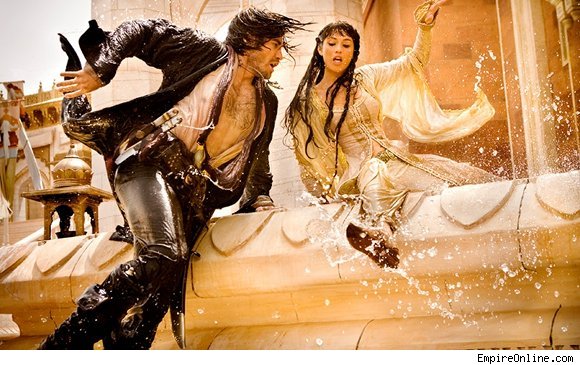
At the very least the actors were nice to look at...

Orientalism aside, the "Lawrence of my labia" pun, made Sex and the City 2 worth my 8 bucks.
ReplyDeleteAlso, Liza Minnelli dancing and singing Beyonce's single ladies was a truly unique and terrifying experience. I had the same look on my face as when i saw Bruno...
:P